This is a lesson plan I developed to integrate The Hunger Games into high school phys ed. It has been written with Grade 9-12 Ontario Healthy Active Living in mind, but could be used as a leadership project with the Grade 12 Recreation and Fitness Leadership course. If you use it, let me know how it went!
Sunday, January 27, 2013

Friday, January 25, 2013
The Hunger Games and the dystopian nature-disconnect

We've spent a lot of time in my literacy class talking about The Hunger Games and how teachers can harness its popularity to make literacy connections across the curriculum. Here are few general thoughts on The Hunger Games to add to the multitude of voices out there.
The Hunger Games as social commentary
The Hunger Games suggests a variety of social issues without going into great depth on any of them. At its heart, it is an action-packed hero’s quest told through the eyes of a strong-but-flawed heroine fighting to survive in a dystopian future. As New Yorker critic David Denby put it, “the reason for its success is simple: it makes teens feel both victimized and important”.
Nevertheless, The Hunger Games is a great starting point for exploring a variety of current environmental and social justice issues. Panem is post-climate change North America, so The Hunger Games’ popularity may partly be due to young peoples’ very real concerns about climate change. And there are parallels with the Occupy movement: Panem’s “99%” live in a state of ongoing environmental strife, food insecurity and resource depletion while the remaining few live in the Capitol, where the nation’s wealth and power are concentrated. Though there may not be a cause-and-effect relationship between The Hunger Games and the Occupy movement, there is certainly an element of art-imitating-life-imitating-art that is worth exploring with students.
The Capitol itself is a leisure dystopia. Living in idle wealth, its residents are obsessed with style and engaged in a never-ending game of physical one-up-manship, going so far as to disfigure themselves to attract notice. Oblivious to the food shortages in the rest of the country, residents eat rich foods and engage in planned bingeing and purging. All this behaviour is only slightly more extreme than our current celebrity culture and standards of beauty, and is a clear metaphor for the world food supply and Western overconsumption (and Hollywood is too close to the Capitol’s geographic location to be a coincidence).
It would be interesting to investigate with students the trend for dystopian settings in young adult fiction over the last few years. Dystopian fiction has typically become more popular in times of social crisis. For example, the triumvirate of twentieth century dystopian fiction (A Brave New World, Farenheit 451 and 1984) was written during the World War II/Cold War years.
The dystopian nature-disconnect
Most fictional dystopias are set in highly urban environments or ravaged wastelands, and even those that are set in relatively healthy landscapes isolate their characters from contact with the natural world, as in Bradbury’s Farenheit 451, where the countryside is the domain of the exiles. The Hunger Games is no different: the land has been wasted, resources have been depleted, citizens are prohibited from wandering freely in the forest and gates surround the districts to separate humans from their natural environment. Wild landscapes and the animals that inhabit them are perceived as dangerous.
Why is this such a common element in dystopian fiction? I think it’s because the primal connection humans have with the land is fundamentally incompatible with dystopian power structures. Beyond providing sustenance, nature has a healing and revitalizing power and is intrinsically linked to human freedom and happiness. Seen through the lens of the Western dualistic nature/culture paradigm, a dystopian superpower cannot not effectively control its subjects if the people have healthy relationships with the land, which is by definition wild and uncontrollable. Excluding nature’s light and beauty excludes hope, which enables control. Separating people from the place in which they live is necessary in dystopian worlds, because a return to nature would lead to rebellion and independence. The staging of the final battle in Star Wars: Return of the Jedi (in which the Rebel Alliance finally succeeds in overthrowing the Galactic Empire) on the lush forest moon of Endor can be seen as an example of this. In The Hunger Games, this is played out through the heroine, Katniss Everdeen.
Katniss has a deep connection to the land, which has been fundamental to her survival throughout her life. As a young girl, the sight of a single dandelion changed Katniss’ life, inspiring her to hunt and forage to keep her family from starving and to provide healing medicines. Because these acts are illegal all resources belong to the state, and wandering in the woods is forbidden Katniss’ relationship with the land defines her as a rebel before the story even begins. Beyond the resources the woods provide, Katniss also finds existential freedom and relief there. This bond with the natural world and the vitality it gives her is in stark contrast to the dreary hopelessness of the other residents of her community, who remain caged within the district fences, and to the shallow, overconsumptive urbanity of the Capitol residents, who do not realize they are imprisoned by their luxury.
Once she enters the Hunger Games arena, it is Katniss’ skill as a forager, hunter and herbalist that enable her to survive. But beyond these superficial skills, I think it’s Katniss’ lifelong immersion in nature that gives her the self-assurance and freedom of mind needed to defy the Capitol and ultimately spark a rebellion against its repressive regime. It would be interesting to do a comparative study of other dystopian novels to explore the links across the genre between nature, rebellion and freedom.
Related to Katniss’ connection with the land, The Hunger Games offers another type of literacy beyond the millions of books its fans have read. As an expert expert hunter and forager, Katniss knows how to read signs in nature as efficiently as readers of books can decode symbols on a page. It is this reading of the land that gives her access to the physical world and enables her survival, and gives educators an opportunity to forge a curricular connection with environmental stewardship and traditional Native ways of knowing. Done with care, the popularity of The Hunger Games could be harnessed as a tool to develop interest in and validation of indigenous culture amongst both Aboriginal and non-Aboriginal youth.
Stay tuned for a lesson plan incorporating The Hunger Games into the phys ed curriculum!
Thursday, January 17, 2013
Guess Who? The Periodic Table!
I developed this game as part of a “creativity in science teaching” assignment. Educational games are excellent ways of providing differentiated instruction in the classroom. At their best, they can hold a students’ attention far longer than a teacher can, allow for differentiated learning through visual, kinesthetic and interpersonal stimulation, increase motivation for learning through playful competition, and encourage oral communication, collaboration and peer teaching between players. Most importantly, they make learning fun.
Game Play
Guess Who? The Periodic Table! is played in the same way as the original Hasbro game Guess Who? The periodic table game cards are designed to be printed and used with the game trays provided with the original game.
At its core, Guess Who? is a modified game of “20 Questions” (see player rules provided with the game cards for details). Note that with either game card, students may ask any questions about an element’s properties (lustrous, flammable, metal, gas, etc.) but may not ask questions about an element’s location on the periodic table, as this would make the game too easy.
Game Card 1: The First 24 Elements
As the title suggests, this card includes only the first 24 elements, and is designed to encourage familiarity with the symbols for and physical and chemical properties of these elements (e.g., density, texture, combustibility, etc.), as mandated by the Ontario Grade 9 Science curriculum.
Students may need to refer to their notes or textbooks to help them formulate appropriate questions about the physical and chemical properties of the elements. Doing so will reinforce learning from lessons, labs and other activities and should be encouraged.
Game Card 2: The Elements and STSE
This game card expands student thinking about the elements beyond their properties to their historical, cultural, economic and environmental significance, and includes some of the lesser-known elements. Most of the information on this game card extends learning beyond the Ontario Grade 9 Science curriculum.
Variation
Though Guess Who? is designed as a two-player game, teachers may print a class set of game cards and provide one to each student, without the game trays. Students could then play in pairs or small groups, stroking out elements as they are eliminated through questioning. Laminated game cards could be reused: students could write on them with dry erase markers, wax crayons or grease pencils.
Skills encouraged
The original Guess Who? is a simple but effective game that encourages a variety of skills that are important to the Ontario science curriculum:
In addition to promoting these skills, Guess Who? The Periodic Table! also encourages students to:
Use in the classroom
Guess Who? The Periodic Table! can be used in the classroom in a variety of ways:
The Ontario Science Curriculum and Guess Who? The Periodic Table
Guess Who? The Periodic Table! encourages thinking in each of the four categories of knowledge and skills identified in the achievement chart for the Ontario science curriculum:
Literacy connections
Guess Who? The Periodic Table can increase student proficiency at reading symbols used in chemistry, particularly the symbols for the elements themselves, as well as various laboratory and cultural symbols (toxicity, radioactivity, gas, etc.).
“The Elements and STSE” game card encourages scientific literacy through connections with etymology and mythology, and can be a way of piquing student interest in various elements and driving them to do further reading on various topics.
Extensions
For students looking for additional challenges, “The Elements and STSE” game card can be used to encourage further study on a variety of topics, including:
The periodic table included with the game cards and instructions is Ptable.com's Dynamic Periodic Table. The Royal Society of Chemistry's Visual Elements Periodic Table is also an excellent resource.
If you use this activity with your students, let me know in the comments how it went!
Game Play
Guess Who? The Periodic Table! is played in the same way as the original Hasbro game Guess Who? The periodic table game cards are designed to be printed and used with the game trays provided with the original game.
At its core, Guess Who? is a modified game of “20 Questions” (see player rules provided with the game cards for details). Note that with either game card, students may ask any questions about an element’s properties (lustrous, flammable, metal, gas, etc.) but may not ask questions about an element’s location on the periodic table, as this would make the game too easy.
Game Card 1: The First 24 Elements
As the title suggests, this card includes only the first 24 elements, and is designed to encourage familiarity with the symbols for and physical and chemical properties of these elements (e.g., density, texture, combustibility, etc.), as mandated by the Ontario Grade 9 Science curriculum.
Students may need to refer to their notes or textbooks to help them formulate appropriate questions about the physical and chemical properties of the elements. Doing so will reinforce learning from lessons, labs and other activities and should be encouraged.
Game Card 2: The Elements and STSE
This game card expands student thinking about the elements beyond their properties to their historical, cultural, economic and environmental significance, and includes some of the lesser-known elements. Most of the information on this game card extends learning beyond the Ontario Grade 9 Science curriculum.
Variation
Though Guess Who? is designed as a two-player game, teachers may print a class set of game cards and provide one to each student, without the game trays. Students could then play in pairs or small groups, stroking out elements as they are eliminated through questioning. Laminated game cards could be reused: students could write on them with dry erase markers, wax crayons or grease pencils.
Skills encouraged
The original Guess Who? is a simple but effective game that encourages a variety of skills that are important to the Ontario science curriculum:
- logical thinking
- deductive reasoning
- observation and visual discrimination
- grouping
- question formulation
- listening and oral communication
In addition to promoting these skills, Guess Who? The Periodic Table! also encourages students to:
- use vocabulary associated with the chemical elements and the periodic table (alkali metals, halogens, noble gases, etc.)
- recognize elemental symbols (Fe, Cl, N, Na, etc.)
- become familiar with the positions of elements and groups on the table
- compare and contrast physical properties of different elements
Use in the classroom
Guess Who? The Periodic Table! can be used in the classroom in a variety of ways:
- as part of a series of hands-on activity centres that allow students to explore scientific concepts and learning with partners or in small groups
- as a group or partner activity to familiarize students with or consolidate learning of the periodic table and the properties of the first 20 elements (students will be able to self-assess their additional learning needs based on how easily they can formulate questions that get them closer to winning the game)
- as a class activity to review learning about the chemical and physical properties of elements and the organization of the periodic table in Grade 9 Science
- a class-wide diagnostic tool at the beginning of the Grade 10 Science chemistry unit to assess how well students remember what they learned in Grade 9
- as a culminating activity, students could develop their own versions of Guess Who? incorporating physical and chemical properties of the elements. Student success at developing this variation would allow for assessment of overall learning about the properties of elements covered in class
- as a tool to inspire greater depth and breadth of learning through independent study in gifted or advanced learners
The Ontario Science Curriculum and Guess Who? The Periodic Table
Guess Who? The Periodic Table! encourages thinking in each of the four categories of knowledge and skills identified in the achievement chart for the Ontario science curriculum:
- Knowledge and understanding (through familiarity with chemical elements and the periodic table)
- Thinking and investigation (through questioning and observing)
- Communication (through oral communication, use of vocabulary and terminology)
- Application (by making connections between science, technology, society, and the environment)
Literacy connections
Guess Who? The Periodic Table can increase student proficiency at reading symbols used in chemistry, particularly the symbols for the elements themselves, as well as various laboratory and cultural symbols (toxicity, radioactivity, gas, etc.).
“The Elements and STSE” game card encourages scientific literacy through connections with etymology and mythology, and can be a way of piquing student interest in various elements and driving them to do further reading on various topics.
Extensions
For students looking for additional challenges, “The Elements and STSE” game card can be used to encourage further study on a variety of topics, including:
- etymology of element names
- history of a particular element’s discovery
- scientist who first isolated or discovered a particular element
- contributions of female chemists
- economic importance of various elements
- environmental risks associated with various elements (bioacummulation in ecosystems, groundwater contamination, impacts of mining)
- toxicity and health risks of various elements
The periodic table included with the game cards and instructions is Ptable.com's Dynamic Periodic Table. The Royal Society of Chemistry's Visual Elements Periodic Table is also an excellent resource.
If you use this activity with your students, let me know in the comments how it went!
Thursday, January 10, 2013
Bridging the gap: Interdisciplinarity in high school sciences and humanities teaching
*This is a paper I wrote for my biology class last month. I considered revising it to make it more blog friendly, but at this point in my career I'm more interested in what practicing teachers think of teaching an integrated curriculum than in giving advice on how to do it, so I've decided to publish it as is. Comments always appreciated!
Introduction
“We can educate a large proportion of our better minds so that they are not ignorant of imaginative experience, both in the arts and in science, nor ignorant neither of the endowments of applied science, of the remediable suffering of most of their fellow humans, and of the responsibilities which, once they are seen, cannot be denied.”
— C.P. Snow, 1959
More than 50 years after C.P. Snow's seminal “two cultures” lecture, in which he exposed the division between the humanities and sciences (Snow, 1959), the polarization between these broad domains continues. More recently, E. O. Wilson (1998) noted that intellectuals trained in the social sciences and humanities have difficulty understanding the how the natural sciences are relevant to social behaviour and policy, while natural scientists do not have the background knowledge to engage with social scientists. Even closely connected domains like environmental policy, ethics, social science and biology each have their own practitioners, language and modes of analysis (Wilson). The result, wrote Wilson, is confusion.
The failure of the disciplinary approach is particularly apparent when one examines multi-systemic issues like climate change. For decades, environmental scientists have been communicating about climate change with little effect on individual behaviour (Groffman et al., 2010). Part of the problem is that, traditionally, ecologists’ efforts to reach non-scientific audiences have been based solely on providing information without taking into account the ways in which people reach judgments (Groffman et al.). Yet decisions about environmental behaviour cannot be separated from the social networks that influence people, such as their values and political context (Groffman et al.). To motivate, enable and empower the public to act on climate change, scientists need to apply insights about these broader social issues and how people learn about science — which requires an understanding of ongoing research in the social sciences, not just environmental science. (Groffman et al.).
There are hopeful signs that the humanities-science gap is being bridged, at least at the university level. For example, ecologists are now calling for communications training for university science students, and interdisciplinary degree programs have been proposed to develop professionals with a strong understanding of the relationship between science and society (Groffman et al., 2010). This training would enable graduates to communicate effectively with the public and the media.
Here in Ontario, one such program is the Environmental Visual Communications program offered jointly by Fleming College and the Royal Ontario Museum.Positioned at the convergence of science and art, the program blends visual communication (photography, videography and design) with strategic communication, marketing principles and science knowledge to communicate environmental messages for public education and engagement about conservation and stewardship (Fleming College, 2012).
Further afield, the University of British Columbia held a workshop in September of 2008 entitled “Integrating Science and the Humanities” to explore the promise and challenges of integration between the natural sciences and the humanities (University of British Columbia, 2008).
This type of interdisciplinary collaboration is essential if we are to address systemic, society-wide problems. Though promising, however, it should be happening earlier, at the secondary and elementary levels. This paper will focus on interdisciplinarity and curricular integration at the secondary level.
What’s wrong with the current model?
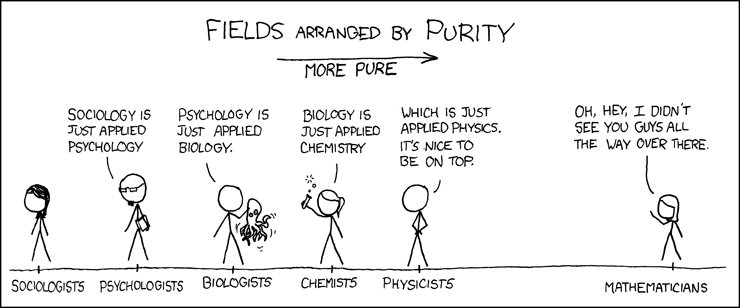
Wilson (1998) noted, “all tangible phenomena, from the birth of stars to the workings of social institutions, are based on material processes that are ultimately reducible, however long and tortuous the sequences, to the laws of physics.” Or, as Randall Monroe notes in the XKCD comic above, to the laws of mathematics. Either way, synthesis and integration are crucial to understanding the connections between the various disciplines.
In the current cellular model of teaching found in most high schools, disciplines are taught one at a time and independently of each other. Teachers are subject matter experts who can offer depth and breadth of content within their disciplines. This structure allows for deep exploration of the ways of thinking and specific skills particular to each field (Fogarty, 2009).
However, this model encourages students to compartmentalize their learning; humanities, sciences and arts are taught with little attempt to connect one discipline to the next, and students are left to make connections on their own (Fogarty, 2009).
Furthermore, overlapping concepts, skills and attitudes are not identified in the cellular model. While concepts and skills that appear across a variety of disciplines are clearly key areas for learning — so a case can be made for learning them multiple times in different disciplinary contexts — this repetition of learning creates more work for students, reduces the transfer of learning to novel situations, and can be tedious (Fogarty, 2009).
The isolation of the current curricular structure is is exacerbated by the system of prerequisites for university and college acceptance, which requires post-secondary-bound students to begin orienting towards their chosen domain in grade 11. The grade 11 course load of an Ontario student hoping to attend a high-ranking university for a highly competitive honours science program could very likely include:
- Mathematical Functions
- Physics
- Chemistry
- Biology
- Earth Sciences
- English
By Grade 12, this same student could be taking:
- Physics
- Chemistry
- Biology
- Advanced Functions
- Calculus
- English
By grade 11, students can have eliminated the humanities (with the exception of English) from their educational careers entirely — before they have had an opportunity to explore and appreciate the connections between the disciplines.
This is problematic when one considers the concept of learning and understanding through semantic frames. A semantic frame is the collection of facts and related concepts unconsciously associated with and that are evoked by a particular word — every word is associated with a semantic frame, and every individual has a unique set of semantic frames based on their own experiences (Lakoff, 2010). Because frames are communicated through language and visual imagery, one must have experience with the language of a particular discipline in order to build a semantic frame for it and to make sense of it (Lakoff).
Understanding issues that involve multiple systems requires frames for each system. In the case of climate change, this includes economics, energy, food, health, trade and security (Lakoff, 2010). Yet as a result of our cellular curriculum, most people don’t have the overall background system of frames needed for deep understanding (Lakoff). Education should give people a variety of frames through which to understand the world. Shunting students into either/or domains limits their capacity to make sense of the world outside of their own discipline.
How does integration improve things?
Interdisciplinarity creates a stronger overall background system of frames by examining multiple modes of thinking and developing a broad range of experiences. An interdisciplinary curriculum provides students with opportunities to investigate complex issues related to real-life experiences and with real-world applications (Fogarty, 2009). These connections to the real world are motivating for students, and deepen their engagement with the curriculum (Drake and Reid, 2010).
For example, Weissman (2004) describes a project where students, upon completing a unit on gravity, motion and states of matter, work with an artist to create clay and marble sculptures. When the sculptures are fired, the marbles will melt; the challenge for students is to sculpt the clay into forms that draw the melted marble into aesthetically pleasing patterns. Projects such as this allow students to engage with curricular content in real, practical ways. As a result, learning is more meaningful and personally relevant (Fogarty, 2009).
Integration can also draw students into disciplines they didn’t think they were interested in, and become a gateway to deeper learning (Fogarty, 2009). For example, a student with a keen interest in visual arts may choose to create a comic book biography about a scientist — say, Nikola Tesla — as a science project. As a result of the student’s personal commitment to the product (a comic book), the student will engage with the scientists’ history — Tesla’s achievements, challenges and time period — in a much more profound way than if they had been required to write an essay or memorize facts for a test. In addition, however, the student also deepens their understanding not only of the mechanics of graphic novelization, but of the potential power of personal narratives and visual storytelling in any discipline.
The above examples of interdisciplinary projects also deepen learning by engaging different types of intelligences (visual-spatial, verbal-linguistic, musical, mathematical, etc.) (Fogarty, 2009).
As the climate change example has shown, the environment isn’t just about the environment: it is deeply connected with many other issues and disciplines (Lakoff, 2010). An interdisciplinary approach is critical to fully understanding these other disciplines, and to synthesizing them into an understanding of climate change. A more connected, integrated curriculum that is organized into complex experiences that immerse students in multiple ways of learning and knowing enables students to think in global, systems terms.
How can teachers begin integrating the curriculum?
Because everybody sees different meanings in the world and different relationships between ideas, curriculum integration looks different for every teacher (Fogarty, 2009). As a result, there are a variety of approaches.
One tactic is to collaborate with other teachers to develop parallel sequencing of topics from different courses so that they coincide with one another (Fogarty, 2009). The cellular nature of the high school system makes integrated curriculum across courses more of a challenge at this level than at the elementary level, but it is possible. Courses can be sequenced so that teaching of related topics happens in parallel, allowing the lessons and activities of each class to support and enhance one another (Fogarty). For example, the study of optics in Grade 10 Science could be sequenced to coincide with an exploration of pinhole cameras in Grade 10 Visual Arts. Sequencing may be most effective in grades 9 and 10, when students’ class schedules are more predictable due to the higher proportion of required courses taken during these years.
Drake and Reid (2010) outline a backwards design approach as an effective way to plan an integrated curriculum within a single course. In this model, teachers scan the curriculum to determine what learning is most important (Drake and Reid). The more a specific learning or theme recurs, the more it is worthy, worldly, and widely influential (Fogarty, 2009). Teachers then choose an issue or theme through which to examine the key learnings. The unit culminates with a rich assessment task that involves multiple subjects, and daily lessons are structured around essential questions that lead to the culminating task.
Creating rich culminating tasks that integrate previously learned knowledge from a variety of disciplines provides subject richness, helps students deepen their understanding of what they already know, and allows for higher-order thinking, problem solving and decision making (Drake and Reid, 2010). A culminating task for Grade 11 Science, for example, could integrate information from any of Grade 9 or 10 Science, Math, Geography, History, English, and Physical and Health Education, since most students will already have completed all of these courses.
Conclusion
Though creating an integrated curriculum requires a fundamental change in practice (Drake and Reid, 2010), the increasing complexity of our world demands it. Integrated education will lead to more trust, collaboration and valuation of alternative methods between academic domains. These changes will be essential to the development of solutions to society’s biggest challenges.
The ever-growing accessibility of information makes interdisciplinary learning more important than ever for individuals, too. The world is in need of synthesizers — people who can sift through information, think critically about it, and make wise choices. By developing individuals who can think around a wide variety of issues and topics, starting at any point and moving in any direction (Wilson, 1998), interdisciplinary education may be the best way to prepare students for for the future.
References
Drake, S. and Reid, R. (2010). Integrated curriculum: Increasing relevance while maintaining accountability. What Works? Research into Practice, Research Monograph #28.
Fleming College. (2012). Environmental Visual Communication. Retrieved December 10, 2012, from http://flemingcollege.ca/programs/environmental-visual-communication
Fogarty, R. (2009). How to integrate the curricula. Thousand Oaks, CA: Corwin.
Groffman, P. M., Stylinski, C., Nisbet, M., et al. (2010). Restarting the conversation: challenges at the interface between ecology and society. Frontiers in Ecology and the Environment, 8 (6), 284-291.
Lakoff, G. (2010). Why it matters how we frame the environment. Environmental Communication: A Journal of Nature and Culture, 4:1, 70-81.
Monroe, R. XKCD: Purity. Retrieved on December 10, 2012, from http://xkcd.com/435/
Snow, C. P. (2001 [1959]). The Two Cultures. London: Cambridge University Press
University of British Columbia. (2008). Integrating science and the humanities. Retrieved December 10, 2012, from http://www.sci-hum.pwias.ubc.ca/
Weissman, D. (2004). You can’t get much better than that. In Rabkin, N. & Redmond, R. (Eds.), Putting the arts in the picture: reframing education in the 21st Century. Columbia College Chicago.
Wilson, E. O. (1998). Consilience: The unity of knowledge. New York: Knopf.
Sunday, December 9, 2012
On being broken, being human and the semiotics of life

This got me thinking about how we do the same thing with the language we choose when we talk about ourselves. When we’re too busy to complete a task, we often say we “didn’t have time.” This is a way of distancing ourselves from the responsibility of having completed the task — it’s a linguistic loophole that lets us pretend that we are not in control of our time and our workload, and therefore not to blame when things don’t happen “on time”. But the truth is, we are in control of how we spend our time. Instead of saying “I didn’t have time for this”, what we really mean is, “I didn’t make time for this.” While this simple word substitution makes us own all the things we didn’t do, it also places us firmly in the driver’s seat of our own lives, which is where we all belong. I consciously made the switch from “having time” to “making time” a few years ago, and even though I still sometimes slip up, it’s amazing how this little change in wording can change your outlook.
Owning your time management skills is small potatoes next to owning your mental health, though, which is what’s on the line when people talk about themselves as “broken” or “damaged.” (I’ll be honest and admit that I’ve done it, too.) But this type of language casts us in the role of victim. It implies that things have been done to us; that we have no control or power over the circumstances of our lives; that, like a plunging market, we are just passive objects being acted upon. This is exactly why many victim support groups eschew the language of victimhood and talk instead about survivorship. Though they are two sides of the same coin, survivorship suggests agency, the idea of playing an active role in one’s continuing survival. Though used extensively by victims/survivors of violence or disease, I think this metaphor is inappropriate for the “survival” of life in general since, for me, it triggers thoughts of strife: images of just scraping by, washed up on one of life’s remote desert islands, existing on wildberries, mushrooms and the occasional raw fish. Surviving, yes, but barely.
Unfortunately, without resorting to New Agey lingo it’s tough to come up with alternative words to express the combination of love, joy, transcendence, pain, heartache and self-doubt that is part of the universal experience of living. A woman I know calls it being an “aliver”. I humbly suggest: “human.” Because the thing is, we’ve all got baggage: it’s called Life. Spend enough time at it and at some point, we all suffer heartbreak and loneliness and the misery brought on by being stuck inside our own heads for too long. This idea of being broken or damaged because of it doesn’t acknowledge the universality of the experience. Maybe that’s the problem: hand-in-hand with the American Dream and it’s magic formula of Hard Work = Success, we suffer the society-wide delusion that if we live right, we’ll always be happy and pain-free. But that’s just not true. If we want to truly own our lives, we need to start acknowledging and validating the pain of living along with the joy.
Monday, November 26, 2012
That hopeless, tired feeling: Mitigating green fatigue in the classroom
A recurring theme in my biology class is how we can incorporate environmental education into our lessons. Today's "hook" was a TED video by Capt. Charles Moore on the seas of plastic garbage that are finding their way into our oceans and the bodies of marine animals everywhere.
This is an important message, and one that, as a former scuba instructor having dived in some of the world's most remarkable marine environments, is not only dear to my heart, but one that I once preached regularly.
However.
The problem with these types of messages isn't just that people don't want to hear them, though of course no one wants to hear (again and again) just how much we've raped and pillaged the planet (especially when they've paid thousands of dollars to be whisked off to a tropical island with sugary white beaches and gently swaying palm trees, surrounded by a blue pancake of an ocean as far as the eye can see, with someone to polish your sunglasses as you sip your second mojito on the balcony of your over-water villa. Not a good time to preach sustainability...). The problem is that we consistently expose youth to these messages as the prelude to and reason for the small environmental actions that we can take to supposedly mitigate the impact of all the negative things we're doing as a species to our home.
I'm not denying the value of taking whatever small steps we can to improve the state of our environment, but I think we're being dishonest if we try to convince ourselves, and especially our youth, that bringing reusable bags to the grocery store will have any measurable short- or medium-term effect on the growing plastic tide in our oceans when multinational corporations the world over are increasing, not decreasing, their production and use of entire documents worth of unpronounceable environmental pollutants. The only effect that these individual actions have is on increasing our overall environmental awareness (for whatever that's worth), and of automatizing positive environmental habits so that when the youth we're educating today finally find themselves at the heads of those same international conglomerates and in a position to take far-reaching decisions, they will do so in a way that is more sustainable for humans and the environment. Which is great, but that's a long time to ask a six-year-old to wait.
Meanwhile, youth are increasingly frustrated at their inability to do positive things now that are on the same scale as the negative things being done by others around them. They get tired of hearing the same old messages of loss and destruction. So they become increasingly despairing and begin to give up. Everyone else is still killing the planet, so what does it matter what they do?
Perhaps the problem is simply the order in which we present the information. Instead of showing students how destructive we're being, show them how they can support our environment, and give them reasons to want to. This should form the bulk of our environmental education, at least until students are mature enough to be able to process the more negative environmental impacts our species is having in a way that won't completely shock, depress and paralyze them.
Environmental marketing agency Futerra released the video "Love, Not Loss" a few years ago along with it's report Branding Biodiversity: The New Nature Message. The report aims to "kill the extinction message" and challenges environmental communicators to pull back on negative messaging about environmental destruction and inspire people to act on conservation based on their love of nature, not their fear of loss.
This video was recently relaunched at the IUCN World Summit in Korea in September, 2012 as part of the IUCN's "Love, Not Loss" campaign. This campaign aims to rekindle the love affair between humans and nature by getting us to remember what it is we loved about it in the first place. Though not aimed specifically at teachers, there are some funny videos about conservation mis-communication, which science and environment teachers could use to lead students into developing their own videos or other products aimed at reminding us of our love, awe and appreciation for the natural world.
On a related note, the Canadian Wildlife Federation provides information about how to make your own Hinterland Who's Who video — they will even provide the HWW logo, classic flute music and a sample script. It's a great multimedia activity that teachers can use as a sneaky way of getting students to learn about a species or habitat, all under the much more entertaining guise of making a video. The instructions are also available as a PDF at WILDEducation.ca, CWF's education division.
I expect that today's generation of youth will be the ones who will have have the critical mix of awareness, power and technology to make real progress on our environmental issues. If we do nothing but instill messages of despair rather than hope, they will suffer from activism fatigue before they even have the chance to be activists — and then what hope do we have?

This is an important message, and one that, as a former scuba instructor having dived in some of the world's most remarkable marine environments, is not only dear to my heart, but one that I once preached regularly.
However.
The problem with these types of messages isn't just that people don't want to hear them, though of course no one wants to hear (again and again) just how much we've raped and pillaged the planet (especially when they've paid thousands of dollars to be whisked off to a tropical island with sugary white beaches and gently swaying palm trees, surrounded by a blue pancake of an ocean as far as the eye can see, with someone to polish your sunglasses as you sip your second mojito on the balcony of your over-water villa. Not a good time to preach sustainability...). The problem is that we consistently expose youth to these messages as the prelude to and reason for the small environmental actions that we can take to supposedly mitigate the impact of all the negative things we're doing as a species to our home.
I'm not denying the value of taking whatever small steps we can to improve the state of our environment, but I think we're being dishonest if we try to convince ourselves, and especially our youth, that bringing reusable bags to the grocery store will have any measurable short- or medium-term effect on the growing plastic tide in our oceans when multinational corporations the world over are increasing, not decreasing, their production and use of entire documents worth of unpronounceable environmental pollutants. The only effect that these individual actions have is on increasing our overall environmental awareness (for whatever that's worth), and of automatizing positive environmental habits so that when the youth we're educating today finally find themselves at the heads of those same international conglomerates and in a position to take far-reaching decisions, they will do so in a way that is more sustainable for humans and the environment. Which is great, but that's a long time to ask a six-year-old to wait.
Meanwhile, youth are increasingly frustrated at their inability to do positive things now that are on the same scale as the negative things being done by others around them. They get tired of hearing the same old messages of loss and destruction. So they become increasingly despairing and begin to give up. Everyone else is still killing the planet, so what does it matter what they do?
Perhaps the problem is simply the order in which we present the information. Instead of showing students how destructive we're being, show them how they can support our environment, and give them reasons to want to. This should form the bulk of our environmental education, at least until students are mature enough to be able to process the more negative environmental impacts our species is having in a way that won't completely shock, depress and paralyze them.
Environmental marketing agency Futerra released the video "Love, Not Loss" a few years ago along with it's report Branding Biodiversity: The New Nature Message. The report aims to "kill the extinction message" and challenges environmental communicators to pull back on negative messaging about environmental destruction and inspire people to act on conservation based on their love of nature, not their fear of loss.
This video was recently relaunched at the IUCN World Summit in Korea in September, 2012 as part of the IUCN's "Love, Not Loss" campaign. This campaign aims to rekindle the love affair between humans and nature by getting us to remember what it is we loved about it in the first place. Though not aimed specifically at teachers, there are some funny videos about conservation mis-communication, which science and environment teachers could use to lead students into developing their own videos or other products aimed at reminding us of our love, awe and appreciation for the natural world.
On a related note, the Canadian Wildlife Federation provides information about how to make your own Hinterland Who's Who video — they will even provide the HWW logo, classic flute music and a sample script. It's a great multimedia activity that teachers can use as a sneaky way of getting students to learn about a species or habitat, all under the much more entertaining guise of making a video. The instructions are also available as a PDF at WILDEducation.ca, CWF's education division.
I expect that today's generation of youth will be the ones who will have have the critical mix of awareness, power and technology to make real progress on our environmental issues. If we do nothing but instill messages of despair rather than hope, they will suffer from activism fatigue before they even have the chance to be activists — and then what hope do we have?
Wednesday, November 21, 2012
Plan B, F-bombs and open classes: the challenges of teaching high school phys ed
They say that those who can’t teach, teach phys ed. But media
portrayals aside, it’s not as simple as you might think. Here are a few
things I learned about teaching physical and health education in my three weeks
of practice teaching at a small, rural high school:
- When it comes to class space, phys ed teachers are incredibly accommodating. It’s not just because they’re nice people — they really don’t have any choice about it. Besides being the place where phys ed usually happens, high school gymnasia are treated like common real-estate within the school and often repurposed for a variety of school-wide functions: photo day, photo re-take day, school assemblies, awards ceremonies, blood donation drives… This happened twice in the three weeks I was on placement. In spring and fall, this isn’t much of a problem since most classes are outside anyway, or can easily be moved outdoors. In winter, though, it takes a little more creative problem-solving. It’s hard to imagine how a music, drama, science, geography or English teacher would handle being told that their classroom just wasn’t going to be available to them for the day, but phys ed teachers are just expected to accept this and make alternative arrangements. And they do, because they really are nice people.
- Teaching phys ed is like dancing a carefully choreographed ballet with the other phys ed teachers in the school. Because there were three phys ed classes running at any given time during the day and only one gym, all three phys ed teachers had to plan out the order and timing of their semesters together. When one class was in the gym, another would be in the fitness room, and the third in the classroom. (Sometimes the gym would be bisected and two classes would share it, but there’s only so many activities you can do with 20 kids in half a gym.) All three classes were coordinated to finish any given unit on the same day (units were typically seven days), so they could rotate together into the next space. Think your class needs an extra day or two in the classroom to finish your sex ed unit because your students took longer to understand the menstrual cycle than you thought they would? You’ll have to negotiate that with the teacher who’s waiting behind you to get into the classroom, or do your condom demo from the gym floor, or just not teach it at all and move into your next activity unit. I can’t think of any other subjects where teachers have to coordinate their use of space so carefully.
- Phys ed, like drama, visual arts, business, tech, parenting courses and the like, are “open”. This means that students from any stream, whether they are workplace, college or university bound, take these courses together. While there are lots of reasons why this is socially beneficial, this is particularly challenging to the teacher. (Yes, I recognize that this type of open classroom is what elementary teachers deal with every day; I still reserve the right to find it challenging.) I love that phys ed’s activity-based curriculum can let our beleaguered kinesthetic learners and struggling academics shine, but this has the effect of masking a lot of learning differences until the first health unit assignment or test gets turned in. This isn’t an insurmountable challenge, but one that I’d never considered before, and I haven't yet figured out how to handle it to my satisfaction.
- Compounding differences in academic ability is the fact that many health units cover topics that elementary school teachers find either difficult or unimportant to teach — like sexual and reproductive health, nutrition, fitness, mental health, drugs and addiction. This poses a particular challenge with grade 9s, who come with a wide range of prior knowledge, despite the fact that they are supposed to have covered these topics in elementary school. It’s hard to cover an entire unit in seven days when you spend the first two shoring up prior-learning knowledge gaps.
- There are also some issues around language. The first is
profanity. Take two parts physical exertion and one part competitiveness,
combine with a jigger of adolescent hormones, and you’ve got yourself an F-bomb
cocktail. I think that putting a complete ban on profanity in phys ed class is
a losing battle — there
are many more constructive ways to use my energy —
but I’m baffled by the lack of internal filters in so many students. It’s one
thing to drop an F-bomb when you miss an easy goal or take a hockey stick in
the shins, but to let them rip in everyday speech is another. Don’t get me wrong,
I can swear like a sailor, but I never would have used that kind of language in
the classroom, and certainly not within earshot of a teacher or parent. How
have language standards changed so much for today’s teens? As adults, they will
have to filter profanity from their speech —
most of them can expect it to be disallowed in their eventual workplaces. Now
would be a good time to start practicing, even if they can see no other reason for
self-censoring.
- Finally, given that there are a lot of balls and sticks in phys ed, it can be incredibly hard to talk about basic sporting equipment without having someone turn it into a dirty joke. Navigating the line between funny ha-ha and funny-awkward isn’t hard, but teenagers just never get tired of it. As an adult, on the other hand (Jason Segel’s balls notwithstanding), I… no, wait, nevermind, jokes about balls are always funny.
Subscribe to:
Posts (Atom)