*This is a paper I wrote for my biology class last month. I considered revising it to make it more blog friendly, but at this point in my career I'm more interested in what practicing teachers think of teaching an integrated curriculum than in giving advice on how to do it, so I've decided to publish it as is. Comments always appreciated!
Introduction
“We can educate a large proportion of our better minds so that they are not ignorant of imaginative experience, both in the arts and in science, nor ignorant neither of the endowments of applied science, of the remediable suffering of most of their fellow humans, and of the responsibilities which, once they are seen, cannot be denied.”
— C.P. Snow, 1959
More than 50 years after C.P. Snow's seminal “two cultures” lecture, in which he exposed the division between the humanities and sciences (Snow, 1959), the polarization between these broad domains continues. More recently, E. O. Wilson (1998) noted that intellectuals trained in the social sciences and humanities have difficulty understanding the how the natural sciences are relevant to social behaviour and policy, while natural scientists do not have the background knowledge to engage with social scientists. Even closely connected domains like environmental policy, ethics, social science and biology each have their own practitioners, language and modes of analysis (Wilson). The result, wrote Wilson, is confusion.
The failure of the disciplinary approach is particularly apparent when one examines multi-systemic issues like climate change. For decades, environmental scientists have been communicating about climate change with little effect on individual behaviour (Groffman et al., 2010). Part of the problem is that, traditionally, ecologists’ efforts to reach non-scientific audiences have been based solely on providing information without taking into account the ways in which people reach judgments (Groffman et al.). Yet decisions about environmental behaviour cannot be separated from the social networks that influence people, such as their values and political context (Groffman et al.). To motivate, enable and empower the public to act on climate change, scientists need to apply insights about these broader social issues and how people learn about science
— which requires an understanding of ongoing research in the social sciences, not just environmental science. (Groffman et al.).
There are hopeful signs that the humanities-science gap is being bridged, at least at the university level. For example, ecologists are now calling for communications training for university science students, and interdisciplinary degree programs have been proposed to develop professionals with a strong understanding of the relationship between science and society (Groffman et al., 2010). This training would enable graduates to communicate effectively with the public and the media.
Here in Ontario, one such program is the
Environmental Visual Communications program offered jointly by Fleming College and the Royal Ontario Museum.Positioned at the convergence of science and art, the program blends visual communication (photography, videography and design) with strategic communication, marketing principles and science knowledge to communicate environmental messages for public education and engagement about conservation and stewardship (Fleming College, 2012).
Further afield, the University of British Columbia held a workshop in September of 2008 entitled
“Integrating Science and the Humanities” to explore the promise and challenges of integration between the natural sciences and the humanities (University of British Columbia, 2008).
This type of interdisciplinary collaboration is essential if we are to address systemic, society-wide problems. Though promising, however, it should be happening earlier, at the secondary and elementary levels. This paper will focus on interdisciplinarity and curricular integration at the secondary level.
What’s wrong with the current model?
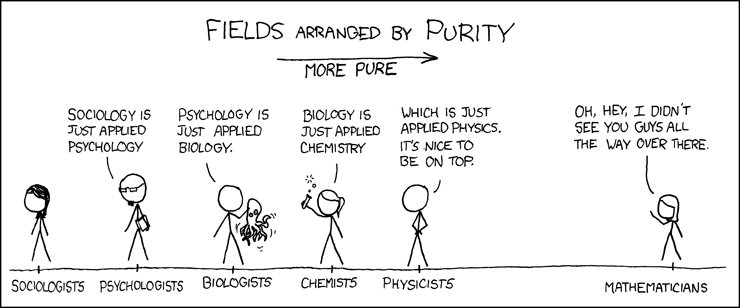
Wilson (1998) noted, “all tangible phenomena, from the birth of stars to the workings of social institutions, are based on material processes that are ultimately reducible, however long and tortuous the sequences, to the laws of physics.” Or, as Randall Monroe notes in the
XKCD comic above, to the laws of mathematics. Either way, synthesis and integration are crucial to understanding the connections between the various disciplines.
In the current cellular model of teaching found in most high schools, disciplines are taught one at a time and independently of each other. Teachers are subject matter experts who can offer depth and breadth of content within their disciplines. This structure allows for deep exploration of the ways of thinking and specific skills particular to each field (Fogarty, 2009).
However, this model encourages students to compartmentalize their learning; humanities, sciences and arts are taught with little attempt to connect one discipline to the next, and students are left to make connections on their own (Fogarty, 2009).
Furthermore, overlapping concepts, skills and attitudes are not identified in the cellular model. While concepts and skills that appear across a variety of disciplines are clearly key areas for learning
— so a case can be made for learning them multiple times in different disciplinary contexts
— this repetition of learning creates more work for students, reduces the transfer of learning to novel situations, and can be tedious (Fogarty, 2009).
The isolation of the current curricular structure is is exacerbated by the system of prerequisites for university and college acceptance, which requires post-secondary-bound students to begin orienting towards their chosen domain in grade 11. The grade 11 course load of an Ontario student hoping to attend a high-ranking university for a highly competitive honours science program could very likely include:
- Mathematical Functions
- Physics
- Chemistry
- Biology
- Earth Sciences
- English
This leaves only two credits with which to explore interests in the humanities.
By Grade 12, this same student could be taking:
- Physics
- Chemistry
- Biology
- Advanced Functions
- Calculus
- English
Again, there would be room for only two additional courses.
By grade 11, students can have eliminated the humanities (with the exception of English) from their educational careers entirely
— before they have had an opportunity to explore and appreciate the connections between the disciplines.
This is problematic when one considers the concept of learning and understanding through semantic frames. A semantic frame is the collection of facts and related concepts unconsciously associated with and that are evoked by a particular word
— every word is associated with a semantic frame, and every individual has a unique set of semantic frames based on their own experiences (Lakoff, 2010). Because frames are communicated through language and visual imagery, one must have experience with the language of a particular discipline in order to build a semantic frame for it and to make sense of it (Lakoff).
Understanding issues that involve multiple systems requires frames for each system. In the case of climate change, this includes economics, energy, food, health, trade and security (Lakoff, 2010). Yet as a result of our cellular curriculum, most people don’t have the overall background system of frames needed for deep understanding (Lakoff). Education should give people a variety of frames through which to understand the world. Shunting students into either/or domains limits their capacity to make sense of the world outside of their own discipline.
How does integration improve things?
Interdisciplinarity creates a stronger overall background system of frames by examining multiple modes of thinking and developing a broad range of experiences. An interdisciplinary curriculum provides students with opportunities to investigate complex issues related to real-life experiences and with real-world applications (Fogarty, 2009). These connections to the real world are motivating for students, and deepen their engagement with the curriculum (Drake and Reid, 2010).
For example, Weissman (2004) describes a project where students, upon completing a unit on gravity, motion and states of matter, work with an artist to create clay and marble sculptures. When the sculptures are fired, the marbles will melt; the challenge for students is to sculpt the clay into forms that draw the melted marble into aesthetically pleasing patterns. Projects such as this allow students to engage with curricular content in real, practical ways. As a result, learning is more meaningful and personally relevant (Fogarty, 2009).
Integration can also draw students into disciplines they didn’t think they were interested in, and become a gateway to deeper learning (Fogarty, 2009). For example, a student with a keen interest in visual arts may choose to create a comic book biography about a scientist
— say, Nikola Tesla
— as a science project. As a result of the student’s personal commitment to the product (a comic book), the student will engage with the scientists’ history
— Tesla’s achievements, challenges and time period
— in a much more profound way than if they had been required to write an essay or memorize facts for a test. In addition, however, the student also deepens their understanding not only of the mechanics of graphic novelization, but of the potential power of personal narratives and visual storytelling in any discipline.
The above examples of interdisciplinary projects also deepen learning by engaging different types of intelligences (visual-spatial, verbal-linguistic, musical, mathematical, etc.) (Fogarty, 2009).
As the climate change example has shown, the environment isn’t just about the environment: it is deeply connected with many other issues and disciplines (Lakoff, 2010). An interdisciplinary approach is critical to fully understanding these other disciplines, and to synthesizing them into an understanding of climate change. A more connected, integrated curriculum that is organized into complex experiences that immerse students in multiple ways of learning and knowing enables students to think in global, systems terms.
How can teachers begin integrating the curriculum?
Because everybody sees different meanings in the world and different relationships between ideas, curriculum integration looks different for every teacher (Fogarty, 2009). As a result, there are a variety of approaches.
One tactic is to collaborate with other teachers to develop parallel sequencing of topics from different courses so that they coincide with one another (Fogarty, 2009). The cellular nature of the high school system makes integrated curriculum across courses more of a challenge at this level than at the elementary level, but it is possible. Courses can be sequenced so that teaching of related topics happens in parallel, allowing the lessons and activities of each class to support and enhance one another (Fogarty). For example, the study of optics in Grade 10 Science could be sequenced to coincide with an exploration of pinhole cameras in Grade 10 Visual Arts. Sequencing may be most effective in grades 9 and 10, when students’ class schedules are more predictable due to the higher proportion of required courses taken during these years.
Drake and Reid (2010) outline a backwards design approach as an effective way to plan an integrated curriculum within a single course. In this model, teachers scan the curriculum to determine what learning is most important (Drake and Reid). The more a specific learning or theme recurs, the more it is worthy, worldly, and widely influential (Fogarty, 2009). Teachers then choose an issue or theme through which to examine the key learnings. The unit culminates with a rich assessment task that involves multiple subjects, and daily lessons are structured around essential questions that lead to the culminating task.
Creating rich culminating tasks that integrate previously learned knowledge from a variety of disciplines provides subject richness, helps students deepen their understanding of what they already know, and allows for higher-order thinking, problem solving and decision making (Drake and Reid, 2010). A culminating task for Grade 11 Science, for example, could integrate information from any of Grade 9 or 10 Science, Math, Geography, History, English, and Physical and Health Education, since most students will already have completed all of these courses.
Conclusion
Though creating an integrated curriculum requires a fundamental change in practice (Drake and Reid, 2010), the increasing complexity of our world demands it. Integrated education will lead to more trust, collaboration and valuation of alternative methods between academic domains. These changes will be essential to the development of solutions to society’s biggest challenges.
The ever-growing accessibility of information makes interdisciplinary learning more important than ever for individuals, too. The world is in need of synthesizers
— people who can sift through information, think critically about it, and make wise choices. By developing individuals who can think around a wide variety of issues and topics, starting at any point and moving in any direction (Wilson, 1998), interdisciplinary education may be the best way to prepare students for for the future.
References
Drake, S. and Reid, R. (2010).
Integrated curriculum: Increasing relevance while maintaining accountability. What Works? Research into Practice, Research Monograph #28.
Fleming College. (2012). Environmental Visual Communication. Retrieved December 10, 2012, from
http://flemingcollege.ca/programs/environmental-visual-communication
Fogarty, R. (2009).
How to integrate the curricula. Thousand Oaks, CA: Corwin.
Groffman, P. M., Stylinski, C., Nisbet, M., et al. (2010).
Restarting the conversation: challenges at the interface between ecology and society. Frontiers in Ecology and the Environment, 8 (6), 284-291.
Lakoff, G. (2010).
Why it matters how we frame the environment. Environmental Communication: A Journal of Nature and Culture, 4:1, 70-81.
Monroe, R. XKCD: Purity. Retrieved on December 10, 2012, from
http://xkcd.com/435/
Snow, C. P. (2001 [1959]). The Two Cultures. London: Cambridge University Press
University of British Columbia. (2008). Integrating science and the humanities. Retrieved December 10, 2012, from
http://www.sci-hum.pwias.ubc.ca/
Weissman, D. (2004). You can’t get much better than that. In Rabkin, N. & Redmond, R. (Eds.),
Putting the arts in the picture: reframing education in the 21st Century. Columbia College Chicago.
Wilson, E. O. (1998).
Consilience: The unity of knowledge. New York: Knopf.